Math 4120 (Algebra I), Fall 2026
Math 4120 (Algebra I), Fall 2026
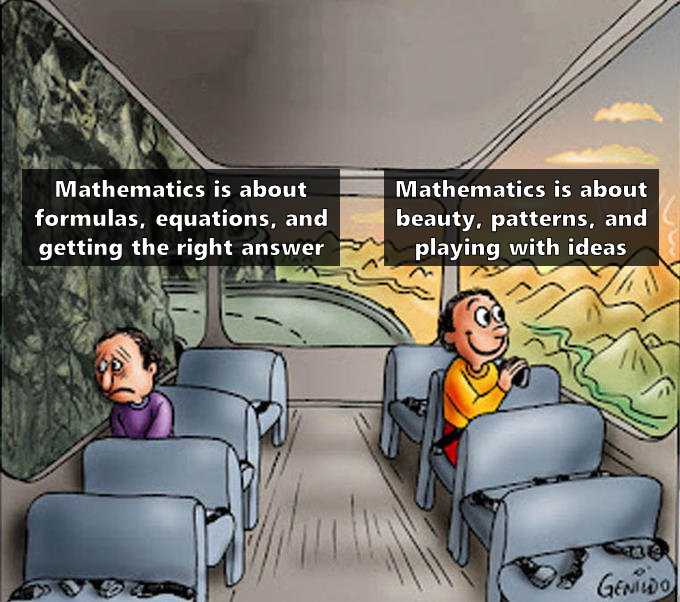 "Mathematics, rightly viewed, possesses not only truth, but supreme
beauty." --Bertrand Russell
"Mathematics, rightly viewed, possesses not only truth, but supreme
beauty." --Bertrand Russell
Symmetry, as wide or narrow as you may define its meaning, is one idea
by which man through the ages has tried to comprehend and create
order, beauty, and perfection. --Hermann Weyl
"If you are someone who prefers large vistas and powerful theories, then it is essential to be able to test general results by applying them to simple examples....where one can do concrete calculations, sometimes with elaborate formulas, that help to make the general theory understandable. They keep your feet on the ground...A good example is a thing of beauty. It shines and convinces. It gives insight and understaning. It provides the bedrock of belief." --Sir Michael Atiyah, in Advice to a young mathematician.
About the class
Group theory is the study of symmetry, and it is one of the most
beautiful areas in all of mathematics. It arises in puzzles, visual
arts, music, nature, the physical and life sciences, computer science,
cryptography, and of course, all throughout mathematics. Yet, it is usually taught with little to no visuals, which is a travesty. The primary reason for this is that every establish books does it this way, and instructors tend to teach it the way the learned it. Without available resources, this will never change. And I'm working to change this. My vision is that in 20 years, students will find it incredulous that this subject used to be taught non-visually. Just like how no one would teach calculus without graphs. Visuals are as essential in group theory as pictures are in fields such as crystallography or art history.
For this course, we will use my textbook Visual Algebra, which I finished writing this summer, but is not yet published. It will be available on Canvas. A few fantastic sources that helped inspire this class include a
2009 general-audience book
called Visual Group Theory (VGT),
by Nathan Carter. The renowned
mathematician Steven Strogatz at Cornell, calls it One of the
best introductions to group theory -- or to any branch of higher math
-- I've ever read. VGT has 300 color illustrations, and focuses on
the intuition behind the difficult concepts in group theory. Another
source is a free e-book called An inquiry-based approach to abstract algebra,
by Dana Ernst. This
follows the "Visual Group Theory" approach, but is more rigorous and
proof-based. However, most of the proofs are not provided; you are
supposed to fill them in. This is what the "inquiry-based" part
means.
In this class, we will discover abstract algebra through beautiful visuals, rigorous mathematics, and concrete examples, such as the Rubik's cube, frieze and wallpaper patterns, roots of unity, matrices, permutations, polytopes, and chemical molecules. The two main visual themes running throughout the course will be Cayley graphs and subgroup lattices. Guided by these pictures and examples, we will develop the structure and theory of groups: subgroups and cosets, products and quotients, homomorphisms and isomorphisms, group actions, conjugacy, automorphisms, semidirect products, and the celebrated theorems of Lagrange, Cayley, Cauchy, and Sylow. We will then turn to rings and fields, studying ideals, quotient rings, ring homomorphisms, maximal ideals, and finite fields. By the end of the semester, you will leave with a new appreciation for the beauty, power, and difficulty of an area of mathematics that, just a few years ago, you may never have imagined existed.
Class essentials
Resources
- Visual Algebra homepage.
- This entire course (Spring 2022 version) in
one long meta Twitter thread of my weekly summary threads, from
@VisualAlgebra.
- My old 46-video Visual Group Theory YouTube playlist. There is some overlap with our materials.
- Homepage of Math 8510, the graduate-level version of this class.
- Homepage of Math 4130, Algebra II (Spring 2023), the follow-up to this class.
- YouTube link to a talk I gave titled What is...a Cayley diagram? at the virtual What is...a seminar?, December 2021.
- YouTube link to a talk I gave titled A visual tour of the beauty of group theory, at the Talk math with your friends seminar, October 2021.
- Visual Group Theory, by Nathan Carter.
Steven Stogatz calls it One of the best introductions to group
theory -- or to any branch of higher math -- I've ever read
- An inquiry-based approach to abstract algebra, by Dana Ernst. Free e-book which follows the "Visual Group Theory" approach. His course materials can be found here.
- LMFDB, a powerful search tool for finite groups.
- Group theory, abstraction, and the 196,883-dimensional monster, a video by the phenomenal Grant Sanderson, aka 3blue1brown.
- A short article on abstract algebra, by Steven
Strogatz, written for a general (non-mathematical) audience that
appeared in the New York Times.
- Abstract Algebra:
Theory and Applications, a free open-source textbook, by Tom
Judson.
- Group Explorer, a free software program to
accompany Visual Group Theory
- The Spin 3x3 group involving a grid of numbers used in Dana Ernst's book: Web app | paper.
- GroupNames, a tremendous resource and database for finite groups.
- Database of ring theory
- The free open source GAP (Groups, Algorithms, Programming) software package, and a nice Mac interface called Gap.app
- Guidelines for good
mathematical writing,
by Francis
Su. (4 pages)
- Francis Su's book Mathematics for Human Flourising, which won the 2021 Euler Book Prize.
- Group theory and
the Rubik's cube,
by Janet
Chen (39 pages).
- Homepage of math
professor and former Rubik's cube world recorder
holder Macky Makisumi. He is interested in speedcubing
theory and runs the
website Cubefreak.
- Gödel, Escher, Bach: An Eternal Golden Braid
is a wonderful, playful, Pulitzer-Prize winning book exploring the
common themes and symmetries underlying mathematics, art, and
music. It was written by Doug Hofstadter, who Nathan Carter cites as an
influence in his writing of Visual Group Theory (both were at
Indiana University).
- New discoveries! Every configuration of the Rubik's Cube Group is at most
20 "moves" from the solved state (Proven July 2010), or 26 "moves" in the quarter-turn metric (Proven August 2014).
- Crystal systems of minerals (lots of pictures, and
references to group theory!)
- Articles on Group
Theory and its Application to Chemistry from LibreTexts, a ChemWiki hosted at UC Davis.
- Tilings in everyday places, by Dror Bar-Natan of the University of Toronto.
Homework
Homework should be written up carefully and
concisely. Please write in complete sentences. Part of your
grade will be based on the presentation and clarity of your
answers. Enough of the problem statements should be copied down so
that your homework solutions are self-contained and the textbook is
not needed to read, understand, and grade them. Along with assignment,
I will post "supplemental material" consisting of blank images that you are
free to use, rather than redraw by hand. The LaTeX files are also posted, but require a custom style file: visualalgebra.sty.
- HW 1: pdf |
tex
| img. Topics: Introduction to groups,
symmetries, and Cayley graphs. Due Monday, August 31,
2026.
- HW 2: pdf |
tex
| img. Topics: Examples of groups, roots of
unity. Due Tuesday, September 8, 2026.
- HW 3: pdf |
tex
| img. Topics: Polytopes and groups of
permutations. Due Monday, September 14, 2026.
- HW 4: pdf
| tex
| img. Topics: Dicyclic, diquaternion, semidihedral,
and semiabelian groups. Automorphisms. Due Monday, September 21, 2026.
- HW 5: pdf
| tex
| img. Topics: Subgroups, cosets, and
normalizers. Due Monday, September 28, 2026.
- HW 6: pdf
| tex
| img. Topics: Normality and
conjugate subgroups. Due Monday, October 5, 2026.
- HW 7: pdf
| tex
| img. Topics: Quotient groups, conjugacy
classes, and centralizers. Due Wednesday, October 14, 2026.
- HW 8: pdf
| tex | img. Topics: Homomorphisms and
isomorphisms. Due Tuesday, October 20, 2026.
Lecture notes
See an explanation below for the story behind these, and why they are a new and improved version of what I thought had converged to something that I would never change! I am in the process of recording YouTube lectures to go along with these, and they can be found here.
- Chapter 1: Groups, intuitvely (57 pages. Last updated Jan 14, 2025)
- Chapter 2: Examples of groups (114 pages. Last updated Jan 15, 2025)
- Chapter 3: Group structure (106 pages. Last updated Feb 19, 2025)
- Chapter 4: Maps between groups (95 pages. Last updated Mar 13, 2025)
- Chapter 5: Actions of groups (138 pages. Last updated Apr 14, 2025)
- Chapter 6: Extensions of groups (115 pages. Last updated July 2, 2025)
- Chapter 7: Universal constructions (97 pages. Last updated Dec 18, 2023)
- Chapter 8: Rings (100 pages. Last updated July 15, 2025)
- Chapter 9: Domains (88 pages. Last updated Jan 8, 2024)
- Chapter 10: Fields
- Chapter 11: Gaolis theory
Exams
 All work is licensed under the Creative Commons BY-NC-SA 4.0 License.